

Ethics & Responsible Sourcing
Responsible manufacturing doesn't begin at our factory door;
We manufacture garments in Auckland, which gives us direct visibility over the people, processes and working conditions involved in our own production. But the garments we make depend on fabrics, zips, fastenings, reflective materials, threads and other components that originate elsewhere.
Responsible manufacturing therefore means looking both at what happens inside our own factory and who sits behind the materials coming through our door.
We don't claim complete visibility across every tier of every supply chain. What we do have is a due-diligence process designed to progressively improve that visibility, retain the evidence we receive and identify where more questions need to be asked.
Our supplier due-diligence process
In 2026 we issued our Ethical & Environmental Supplier Questionnaire to our suppliers, requesting information and supporting documentation covering:
labour practices, including child and forced labour;
employment conditions;
worker health and safety;
environmental management;
chemical management;
waste management; and
relevant third-party certifications and audits.
We retain the completed questionnaires and supporting documentation and review the information supplied.
As new suppliers are introduced, they are brought into the same process, and where information or evidence is incomplete we go back and ask further questions.
Importantly, we distinguish between what a supplier has declared themselves and what is supported by certification, third-party auditing or other evidence.
A signed questionnaire is information. It isn't automatically independent verification.
Where our materials come from
Our technical fabrics are sourced primarily from suppliers in Australia, the United States, China and India, depending on the fabric and its performance requirements.
Although that is geographically broad, our principal technical-material supply base is relatively small. Many of our supplier relationships are established and long-standing, and changing a technical fabric or component supplier can be a significant decision because performance, quality, compliance and continuity all matter.
Long relationships are useful, but we don't treat familiarity as a substitute for due diligence.
When assessing materials and suppliers, price isn't our only consideration. Technical performance and quality matter, and we are increasingly incorporating the availability of appropriate supplier and responsible-sourcing information into the decision as well.
Looking beyond our direct suppliers
Knowing who supplied something directly to Jaedon is only the first layer.
Some specialised materials and components are purchased through intermediaries. In those situations we review the intermediary's own responsible-sourcing policies and documentation, but we are also progressively looking beyond them to understand the suppliers they purchase from on our behalf.
For example, one intermediary supplies some of our fastenings. In addition to providing us with its own sourcing policies and procedures, we have asked it to collate information and credentials relating to the underlying suppliers from whom those components are sourced. That information is progressively being provided and retained on file.
For new materials sourced through that intermediary, relevant supplier information is now requested alongside technical datasheets and other product information.
The objective is simple: responsible-sourcing information should increasingly form part of the sourcing decision itself, rather than being something we investigate after a material has already been selected.
Direct engagement matters too.
Where practical, we also engage directly with significant suppliers.
During 2026 we met with one of our significant Australian suppliers in Australia. Jaedon has previously visited a significant US supplier, and one of our largest Chinese suppliers is scheduled to visit us in October 2026.
As part of that upcoming engagement, we intend to ask the Chinese supplier to take us further upstream: where do their yarns come from, who supplies them, and what processes do they use to assess those suppliers?
That next layer is important because the company selling us fabric is itself relying on fibres, yarns, chemicals, energy, labour and other inputs from further back in its own supply chain.
How far can we trace?
We don't currently claim that we personally know with certainty that every component of every garment can be traced back through every stage to its original raw material and independently verified as ethically sourced.
For some materials we have considerably more information than others.
Visibility generally becomes more difficult as you move further upstream: from Jaedon to our direct supplier, from the fabric manufacturer to its yarn supplier, from yarn to fibre, and eventually to the harvesting or production of the original raw material.
At each stage, businesses rely to some extent on the organisations closest to the preceding stage undertaking their own due diligence.
Our job is therefore not to pretend those gaps don't exist. It is to progressively understand who sits behind our supply chain, what checks are being undertaken and what evidence supports them.
Sedex
Jaedon Manufacturing is a Sedex member.
Sedex provides systems and tools for businesses to manage and share responsible-sourcing information relating to areas including labour standards, health and safety, environmental performance and business ethics.
Sedex membership should not be confused with certification. We describe ourselves as a Sedex member, not “Sedex certified”.
Our membership forms one part of our wider responsible-sourcing and supply-chain due-diligence programme.
Our expectations
Within our own operations, Jaedon does not accept forced labour, human trafficking, child labour or coercive employment practices.
We expect suppliers and contractors to operate in accordance with applicable laws and maintain appropriate practices relating to:
Labour and human rights; including the prohibition of forced and child labour and lawful employment conditions.
Health and safety; systems and practices appropriate to protecting workers from foreseeable workplace risks.
Environmental responsibility; compliance with relevant environmental requirements and appropriate management of environmental impacts, including chemicals and waste.
Business ethics; lawful business conduct and appropriate controls concerning bribery, corruption and fraud.
Where relevant, we request policies, declarations, certifications, audit information and other supporting evidence relating to these expectations.
Evidence, not assumptions
Our approach to responsible sourcing follows the same principle we apply to our environmental claims.
We distinguish between:
what we know directly;
what a supplier has told us;
what documentation supports;
what has been independently audited or certified; and
what we are still working to establish.
We haven't discovered an existing supplier being deliberately untruthful through this process and subsequently stopped trading with them. We have, however, chosen not to proceed with suppliers when we couldn't establish sufficient information to satisfy our requirements.
Our supply-chain visibility isn't finished, and we don't expect it ever to become a simple tick-box exercise. As our information improves, we will continue looking further upstream, updating supplier records and asking more detailed questions.
Questions we're sometimes asked
1. What is Jaedon’s position on child labour, forced labour and modern slavery?
Jaedon does not accept child labour, forced labour, human trafficking or coercive employment practices within our own operations or supply chain.
Our employees are adults with legal working rights in New Zealand, and our expectations regarding labour and human rights are incorporated into our supplier due-diligence process and Supplier Code of Conduct.
We maintain a Modern Slavery Policy and apply these principles as part of our approach to responsible sourcing.
2. How do you assess labour and ethical risks within your supply chain?
We ask suppliers to provide information and supporting documentation relating to labour practices, employment conditions, worker health and safety, environmental management, chemical and waste management, business ethics and relevant certifications or audits.
Importantly, we distinguish between what a supplier tells us and what has been independently verified.
Where information is incomplete, we ask further questions. Where we cannot establish sufficient information to satisfy our requirements, we may choose not to proceed with that supplier.
3. Do you audit supplier factories yourself?
We do not currently operate a formal programme of independent factory audits or structured worker interviews across our supply chain.
Where practical, we engage directly with significant suppliers and visit supplier operations. We also review available policies, certifications, audit information and other supporting evidence.
We are progressively looking further upstream as our supply-chain information develops. Our aim is not to claim visibility we don't have; it is to keep improving the visibility we do have.
4. What happens if you identify serious unethical practices within your supply chain?
Any credible concern involving forced labour, child labour, human trafficking or other serious unethical practices would be investigated rather than ignored.
The appropriate response would depend on what had occurred, the evidence available and whether the issue could be effectively addressed. Where continuing a supplier relationship could not be justified, we would cease that relationship and source an alternative.
Our priority is to make responsible decisions based on evidence rather than simply having a policy on file.
5. Does Jaedon measure greenhouse gas emissions and environmental impacts?
We have not yet completed a full Scope 1–3 greenhouse gas inventory or formal climate-risk assessment.
Our current focus is on building better information about our environmental impacts while taking practical action in areas we can directly influence: reducing production waste, extending garment life through durability and repair, improving responsible sourcing, recycling suitable textile waste and considering freight and supply-chain efficiency.
Our Auckland manufacturing operation does not undertake textile dyeing, washing or chemical processing, and we do not discharge production wastewater.
Where relevant, we also request environmental information from the suppliers responsible for upstream processes such as fabric manufacture.
6. How can customers assess Jaedon’s ethical and responsible-sourcing practices?
We retain supplier questionnaires and supporting documentation as part of our due-diligence process, maintain company policies covering relevant areas, and can provide our compliance pack to customers where appropriate.
Jaedon is also a Sedex member with an active supplier profile. Sedex membership is one part of our responsible-sourcing programme; it is not a certification of our supply chain.
7. Can we visit your factory?
Absolutely. In fact, we encourage it.
Come and see where we work, how our garments are made and the conditions in which our people work. Talk to our team, look around the factory and ask us questions.
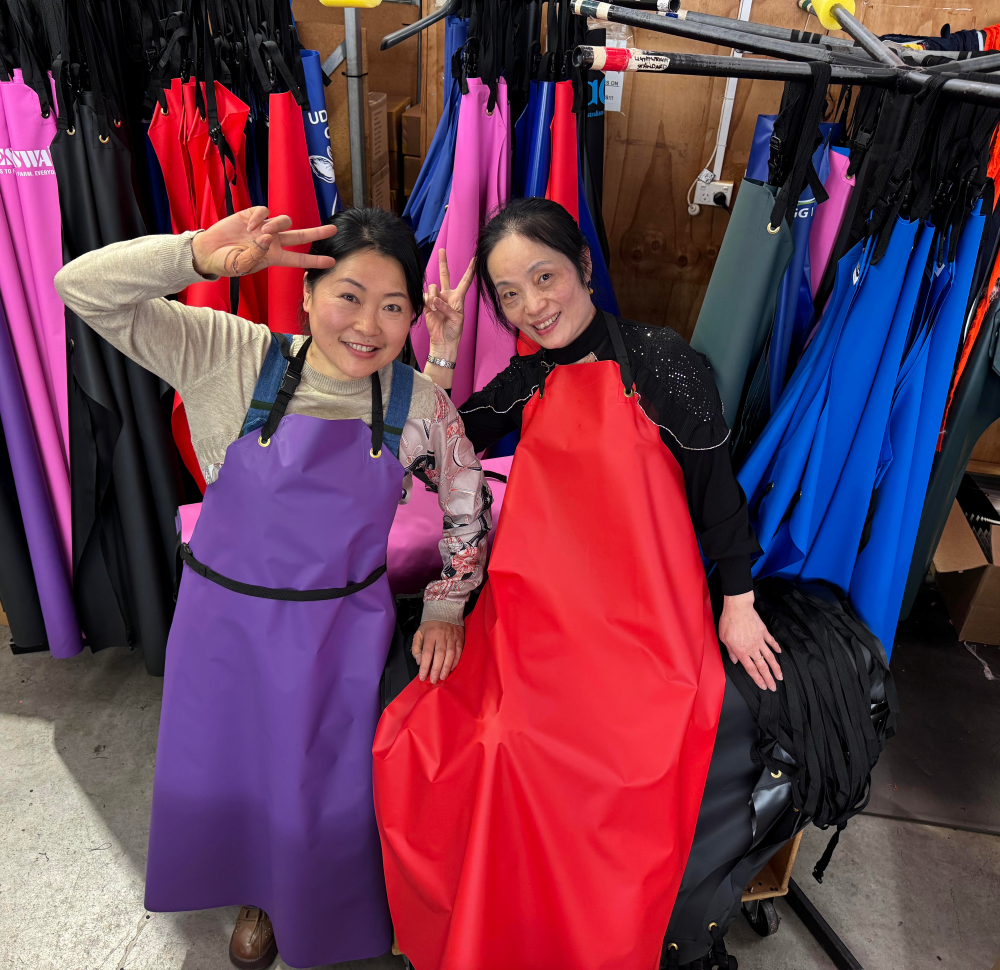
We believe transparency is more meaningful when you can see things for yourself.
Don't just take our word for it: come and see.
Read more about sustainability here